

Sure the organization that ran National Novel Writing Month has shut down, but that doesn’t mean you can’t dedicate the month of November to starting/finishing that book that’s been simmering inside you.
In case you’re unfamiliar, the goal was to write 50,000 words within the month of November. You can accomplish this by writing a minimum of 1667 words per day. It can feel daunting, but I wrote the bulk of my novel Her Dying Day during November.
And I could get all those words onto the page because I took the month of October to prepare.
- Outline
- Characters
- First Scene
- Last Scene
- Short Synopsis
1. Outline
It can be involved, or it can be the barest of bones. But you’re giving yourself a roadmap. Here’s what I recommend you sketch out.
- Starting point
- Inciting act
- Fun and games ideas
- Midpoint
- Dark night of the soul
- Climatic scene
The fun and games section is the bulk of the action. You can use your character’s emotional reactions to help guide your story through the action to get you to the midpoint, the “all is lost” moment, and the finale.
If you haven’t read Save the Cat Writes A Novel, by Jessica Brody you should. (Her blog is also amazing.) If you’re writing a romance, read Romancing the Beat, by Gwen Hayes. These two are my constant companions when I’m outlining.
The outline can help you chunk up your book in to more manageable bites. It can be daunting to write an entire novel. But if you just have to write the set up today, and then the kick off of the action tomorrow, then the midpoint with the false win or the false loss next week, and then fun and games followed by the Dark Night of the Soul the next week? Much easier to deal with mentally.
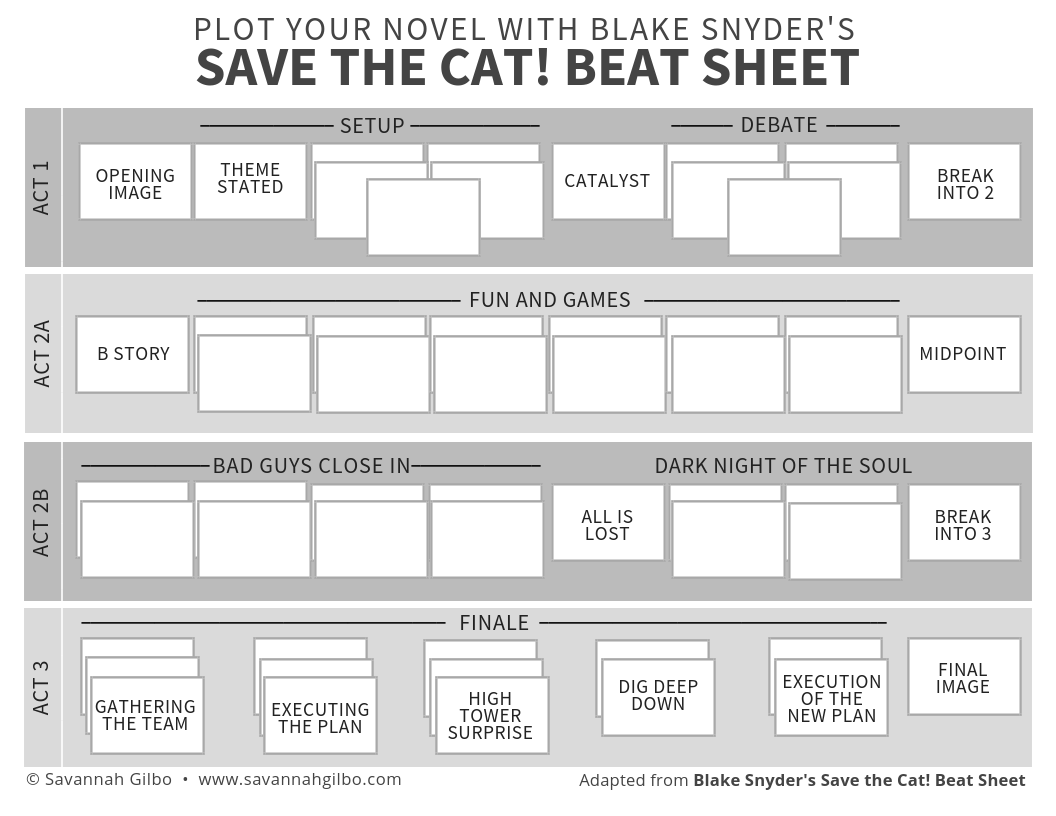
Savannah Gilbo put together this beat sheet for the screen writing version of Save the Cat. It’s got essentially the same beats as a novel and I find a visual like this super helpful.
2. Characters
There are a thousand character sheets on the internet. You can search around and find the one that speaks to you. But the important things are knowing what they look like, knowing what they want, and knowing what they need.
What they want and what they need are two different things. For example, I’m writing a story where my hero wants to be helpful to everyone around him. He opens a new business because his sister needs a place to work, he joined the school board because they couldn’t find anyone else to run, and he drops everything and helps an old flame who broke his heart. But he wants this because he needs to discover his self-worth isn’t dependent how others value him.
The need is the lesson he’s going to learn. The want can help set up some of the fun and games.
You might also want to figure out their fatal flaw. That’s thing that’s going to get them into trouble.
Basically, figure out all the ways you can torture them and their emotional arc/journey before you start writing.
3. First Scene. 4. Last Scene.
The first scene is where we meet our hero. Our introduction to who they are and what situation they’re in. It sets the tone and narrative voice for the novel.
I tend to write this scene 3 different ways. I find the first two write-ups are pretty ho-hum with an expected and not very creative sequence of events. The third way is where this story comes to life.
For Her Dying Day, I wrote that first scene chronologically in first person, then chronologically in third person. Then June really started speaking to me and her sarcastic, humorous voice came out on the page and set the tone for the novel.
The purpose of writing the last scene second is to give you a target to shoot for. It’s the climax of the emotional or physical tension you’ve been building. If you know how high you need to twist the pressure you can plan your “ratcheting points” along the way.
The last scene is one that changed several times for me over the course of the book. But I had a confrontation scene between the villain and the hero and the emotional core and structure of the tension throughout the book stayed the same.
5. Short Synopsis
Writing a short synopsis is my way of spitting out all the important points I want to hit along the way, but in a story kind of mode. It can be seen as a kind of outline, but a more prose-based one that includes the themes, wants, and needs of your hero. But all in one page.
It gives me a gestalt view of my work – the beginning, midpoint, dark night, and end all in a one-page document.
This is helpful to have if your publisher wants a preview of whatever it is you’re working on. Or, if you don’t have an agent yet, is a great place to start when you’re putting together your query letter and need a brief and pithy summary of your novel.
Spending the time these next 2 weeks building this roadmap is going to help so much. Come November 1st, you’ll be able to sit down at your laptop or notebook and start writing your first 1667 words.

 Mindy Carlson
Leave a reply to A Gift for NaNoWriMo – Mindy Carlson Cancel reply